
Proposition 19 and Inherited Property in California: What Happens to Your Property Taxes?

If you inherit a home in California, one of the biggest financial surprises may come from the property tax bill.
For many years, California parents could pass certain real estate to their children while allowing them to retain the property’s existing assessed value under the prior parent-child exclusion rules.
Proposition 19 changed those rules significantly.
Today, an inherited home may be reassessed based on its market value unless specific requirements are met. For a Bay Area property that has been owned for decades, the difference between the parent’s old taxable value and today’s market value can be substantial.
But Proposition 19 has another side that can benefit homeowners—particularly people age 55 or older who want to sell their longtime home and move somewhere else in California.
This guide explains both sides of Proposition 19 and how they may affect your decision to keep, inherit, or sell a California home.
Important: Proposition 19 and California property-tax rules can be complicated, and the result depends on the facts of each transfer. This guide provides general information and is not legal or tax advice. Before making decisions involving an inheritance, property transfer, or tax-base transfer, consider speaking with the county assessor and an appropriate tax or legal professional.
In This Guide:
- What Is Proposition 19?
- Proposition 19 and Inherited Homes
- When Can an Heir Keep the Parent’s Tax Base?
- What Happens If the Heir Doesn’t Move Into the House?
- How Much Can Property Taxes Increase?
- What If Several Children Inherit the House?
- Keeping, Renting or Selling an Inherited Home
- Proposition 19 Can Also Help Homeowners 55+ Who Move
- FAQ
What Is Proposition 19?
California voters approved Proposition 19 in November 2020. Different portions of the law became operative in 2021.
For homeowners and their families, Proposition 19 made two particularly important changes.
First, it changed the rules that allow parents and children—and in more limited circumstances grandparents and grandchildren—to transfer property without a full reassessment.
Second, it expanded the ability of qualifying homeowners age 55 or older, severely and permanently disabled homeowners, and certain victims of wildfire or natural disaster to transfer the taxable value of a principal residence to a replacement principal residence. (California State Board of Equalization)
For many Bay Area families, these two provisions can have very different effects.
An heir may face a higher property-tax assessment after inheriting a parent’s house.
At the same time, a homeowner age 55 or older may be able to sell a longtime residence and take a relatively low taxable value with them when purchasing another California home.
Proposition 19 and Inherited Homes
Before Proposition 19, California’s previous rules provided broader property-tax exclusions for certain transfers between parents and children.
For transfers occurring on or after February 16, 2021, Proposition 19 generally limits the parent-child exclusion to a family home that was the parent’s principal residence and becomes the principal residence of at least one eligible child, subject to the applicable value limitation. Family farms have separate provisions. (California State Board of Equalization)
This distinction is extremely important.
Simply inheriting your parent’s house does not automatically mean you can continue paying property taxes based on your parent’s old taxable value.

When Can an Heir Keep the Parent’s Property-Tax Treatment?
For an inherited family home to qualify for Proposition 19’s parent-child exclusion, several requirements must be satisfied.
Among the key requirements, the property must have been the parent’s principal residence, and at least one eligible child receiving the property must use it as their own principal residence and claim the appropriate homeowners’ or disabled veterans’ exemption.
There is also a value limitation.
For changes in ownership occurring from February 16, 2025 through February 15, 2027, the Proposition 19 adjustment amount is $1,044,586. That amount is periodically adjusted rather than remaining permanently at the original $1 million figure. (California State Board of Equalization)
If the property’s market value exceeds the parent’s factored base-year value plus the applicable adjustment amount, the excess is added to the taxable value even if the other requirements for the exclusion are satisfied.
That can be particularly important in the Bay Area, where a home purchased decades ago may now be worth considerably more than its taxable value.
What Happens If the Heir Doesn’t Move Into the House?
This is one of the most important Proposition 19 issues for heirs.
Suppose your parents lived in their house for 30 or 40 years and you inherit it. You already own your own home and don’t intend to move into your parents’ property.
Under Proposition 19, the inherited home generally won’t qualify for the parent-child exclusion simply because you’re their child. The family-home exclusion requires the inherited property to become the principal residence of an eligible transferee. (California State Board of Equalization)
Similarly, a parent’s rental property generally does not qualify for the Proposition 19 family-home parent-child exclusion. (California State Board of Equalization)
That can dramatically change the economics of keeping an inherited property.
How Much Can Property Taxes Increase After an Inheritance?
Consider a simplified example.
Suppose your parents bought a Bay Area home many years ago, and its current taxable value is approximately $300,000.
If the property is now worth $1.5 million, a reassessment can produce a much higher taxable value than the family had been accustomed to.
The exact tax bill depends on the assessed value and local taxes and assessments, so you should obtain actual figures from the county rather than relying on a simple percentage estimate.
The important point is that an heir shouldn’t assume the parents’ existing property-tax bill will continue unchanged.
Before deciding to keep an inherited property, find out what the new taxable value and estimated property taxes are likely to be.
Proposition 19 Doesn’t Automatically Mean You Should Sell
A higher property-tax bill doesn’t necessarily mean selling is the right decision.
You may still want to keep the house because you plan to live there, because it has sentimental value, or because it works financially as a long-term investment.
The useful question is:
What will this property actually cost me to own after the inheritance?
Consider:
- Property taxes after reassessment
- Insurance
- Mortgage or other debt
- Repairs and deferred maintenance
- Utilities
- HOA dues, if applicable
- Rental income if you plan to rent it
- Property management and maintenance
- The property’s market value
- Potential income-tax and estate considerations
Once you understand those numbers, you can make a more informed decision about keeping, renting, or selling.
What If Several Children Inherit the House?
Multiple heirs can make the decision more complicated.
One child may want to keep the family home. Another may want their share of the inheritance in cash. A third may prefer to rent the property.
Proposition 19 adds another issue: whether an eligible child will actually occupy the family home as a principal residence.
The California Board of Equalization states that when a qualifying family home is transferred to multiple children, not every child must live there. At least one eligible child can satisfy the principal-residence requirement, provided the other requirements are met. (California State Board of Equalization)
However, ownership, buyouts between siblings, estate administration, financing, and tax consequences can become complicated. Those issues may warrant professional legal and tax advice.
Keeping, Renting or Selling an Inherited Home
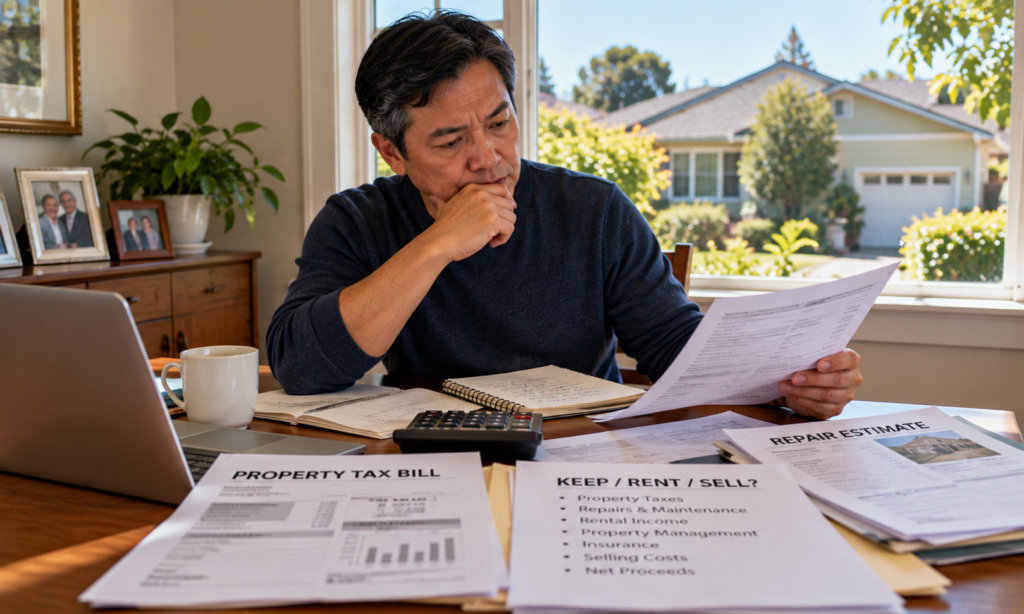
When you inherit a Bay Area property, there are generally several paths to consider.
Keep It and Live There
If the house was your parent’s principal residence and you make it your own principal residence, you may potentially qualify for Proposition 19’s intergenerational exclusion if the other requirements are satisfied.
Keep It as a Rental
If you don’t occupy the inherited family home as your principal residence, the Proposition 19 family-home exclusion generally won’t apply. That means you should understand the property’s post-transfer tax burden before deciding whether the rental makes financial sense. (California State Board of Equalization)
Sell the Property Traditionally
If the house is in good condition—or you’re willing to prepare it for market—a traditional listing may expose the property to a broad pool of buyers.
Sell the Property As-Is
An inherited house may contain decades of belongings or require significant repairs, cleanup or updating.
If the heirs don’t want to spend the time or money preparing it for a conventional sale, an as-is sale may be another option.
The right decision depends on the property’s condition, the heirs’ goals, the estate, and the financial consequences of keeping the property.
Proposition 19 Can Also Help Homeowners 55+ Who Move
Proposition 19 doesn’t only affect inherited property. It also expanded California’s property-tax portability rules for qualifying homeowners age 55 or older.
A qualifying homeowner may be able to sell a principal residence and transfer its taxable value to a replacement principal residence anywhere in California, subject to Proposition 19’s requirements.
This can be useful for longtime homeowners who want to downsize, move closer to family, or relocate to another part of California but are concerned about giving up the low taxable value of their current home.
If you’re considering selling, this is worth discussing with your county assessor or tax professional before completing the transaction.
Proposition 19 and Bay Area Homeowners
Proposition 19 can influence two very different real-estate decisions.
For an heir, it may mean asking:
“Can I afford to keep the house after it is reassessed?”
For a longtime homeowner over age 55, it may mean asking:
“Can I finally sell this house and move without giving up the property-tax advantage I’ve built over the years?”
Those are very different situations, but both can affect whether selling makes financial sense.
If you’re considering selling, I can help you look at the real-estate side of the decision—including the property’s likely value, condition, potential sale options, and what a traditional sale versus an as-is sale might look like.
For the tax consequences themselves, your county assessor and qualified tax or legal professionals should be your sources for advice specific to your situation.
Frequently Asked Questions
Does Proposition 19 eliminate the parent-child property-tax exclusion?
No. It significantly changed and narrowed it. A qualifying transfer of a family home can still receive an exclusion when the requirements are satisfied, including the principal-residence requirement and applicable value limitation. (California State Board of Equalization)
If I inherit my parents’ house but don’t live there, can I keep their tax base?
Generally, the Proposition 19 family-home exclusion requires the inherited property to become the principal residence of at least one eligible transferee. If nobody qualifies and occupies it as required, the exclusion generally will not apply. (California State Board of Equalization)
Does an inherited rental property qualify?
A parent’s rental property generally does not qualify for the Proposition 19 parent-child family-home exclusion because that exclusion is limited to the transferor’s family home that becomes the transferee’s family home, or a qualifying family farm. (California State Board of Equalization)
If two children inherit the home, do both have to move in?
No. The BOE says at least one eligible child can satisfy the residence requirement if the other requirements are met. (California State Board of Equalization)
Can a homeowner over 55 transfer their property-tax base anywhere in California?
Yes, if the Proposition 19 requirements are satisfied. The replacement principal residence can be located anywhere in California. (California State Board of Equalization)
How many times can someone over 55 use Proposition 19?
A qualifying homeowner age 55 or older can use the base-year-value transfer up to three times. (California State Board of Equalization)
Does the replacement house have to cost less?
No. A more expensive replacement property can qualify, but some of the difference in value may be added to the transferred taxable value. (California State Board of Equalization)
How long do I have to buy a replacement home?
Generally, the replacement principal residence must be purchased or newly constructed within two years of the sale of the original principal residence, subject to the complete eligibility rules. (California State Board of Equalization)
Need Help Understanding Your Real Estate Options?
A property-tax reassessment doesn’t mean you have to sell an inherited house. But it can change the financial calculation.
If the property needs repairs, is sitting vacant, contains years of belongings, or is shared among several heirs, a higher ongoing property-tax expense may be one more reason to decide whether keeping the house still makes sense.
Before making that decision, it can help to compare the alternatives:
Keep the property: Understand the new property taxes, insurance, repairs and other carrying costs.
Rent the property: Estimate realistic rental income and compare it with taxes, maintenance, management and other expenses.
Sell traditionally: Prepare the property for market and expose it to the largest possible pool of buyers.
Sell as-is: If you don’t want to make repairs, clean out the property or spend months preparing it for sale, an as-is sale may be another option.
I work with Bay Area property owners who are trying to make exactly this type of decision. I can help you compare what the property may sell for traditionally versus what an as-is sale could look like, so you can decide which approach makes the most sense for your situation.
Call Eddie at 650-980-9819.
There’s no obligation. Before deciding whether to sell, it can be helpful simply to understand what the property may be worth and what your selling options look like.
Let’s Talk About Your Property
If you’d rather contact me online, use the form below and tell me a little about the property and your situation.
Let’s Talk About Your Options
Whether you sell to me, list with an agent, or simply want to understand your options, I’m happy to help.